Flat-Rate Vs. Free Shipping: Which Ammo Retailer Model Actually Saves Your Money?
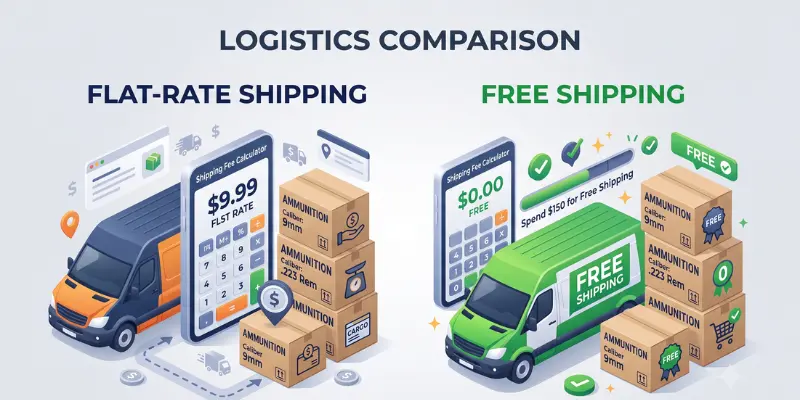
The two most common shipping promotions you encounter online are Flat-Rate Shipping and Free Shipping.
So, which option actually saves you money: flat-rate shipping or free shipping? The answer depends on your order value, the quantity you are buying, the retailer's pricing, and the shipping rules that apply to your order.
In this guide, we explain how both shipping models work, compare realistic pricing examples, and show how to calculate the actual cost of ammunition before choosing a retailer.
Flat-Rate Shipping Explained: How It Works, Pros, Cons & Hidden Costs
Flat-rate shipping means a retailer charges a predetermined shipping fee for an eligible order, regardless of certain changes in order value or package size within the retailer's stated limits.
However, flat-rate shipping does not necessarily mean every order costs the same to ship. Retailers may apply different fees based on order value, destination, package weight, shipping method, or product restrictions. Always check the retailer's actual terms.
How Flat-Rate Shipping Affects Your Total Cost
Consider a hypothetical retailer that charges a flat $14.99 shipping fee.
| Item | Smaller Order | Larger Order |
| Product cost | .$50.00 | $150.00 |
| Shipping Fee | $14.99 | $14.99 |
| Total Before Tax | $64.99 | $164.99 |
| Shipping as a percentage of product cost | 29.98% | 9.99% |
The shipping fee is identical in both cases, but its impact is very different.
For the $50 order, shipping adds almost 30% to the merchandise cost. For the $150 order, the same fee adds about 10%.
This illustrates an important principle: a fixed shipping charge generally has a smaller percentage impact as the order value increases.
Advantages of Flat-Rate Shipping
- Predictable costs: You can estimate the delivery charge before placing an order when the fee and eligibility rules are clearly stated.
- Useful for smaller orders: A flat fee may be less expensive than a variable shipping charge for a comparable order.
- Less dependence on order value: If the fee remains fixed within the eligible range, adding products does not automatically increase shipping.
- Easier price comparisons: A known shipping fee makes it simpler to calculate the total cost before checkout.
Where Flat-Rate Shipping Can Become Expensive
A flat fee can still make an inexpensive product a poor overall deal. For example, saving $5 on ammunition but paying $15 for shipping results in a net cost that is $10 higher than the alternative if the other retailer offers the same product without a shipping charge.
It is also important to check whether the advertised flat rate applies to the exact product, quantity, and destination. A fee shown on a retailer's general shipping page may not apply to every order.
Free Shipping Explained: How It Works, Pros, Cons & Hidden Costs
Free shipping means the retailer does not charge a separate shipping fee for an order that qualifies under its terms.
There are several common versions of this model:
- Unconditional free shipping: Eligible purchases receive free shipping without a minimum merchandise spend, subject to the retailer's other terms.
- Free shipping above a minimum: Shipping becomes free once an order reaches a specified merchandise value.
- Promotional free shipping: A temporary offer removes shipping charges for eligible purchases during a promotion.
- Membership-based free shipping: Certain customers qualify through a paid or otherwise restricted membership program.
The distinction matters because seeing a free-shipping message does not automatically mean every product or order qualifies.
For ammunition purchases, verify whether the offer applies to ammunition itself, the selected package quantity, and your delivery address. Also check whether the threshold is calculated before or after discounts and whether taxes or other charges are treated separately.
How Free Shipping Affects Your Total Cost
Suppose two retailers list the same ammunition, but one charges $14.99 for shipping while the other offers free shipping on qualifying orders.
| Item | Retailer A | Retailer B |
| Product cost | $135.00 | $149.00 |
| Shipping | $14.99 | $0.00 |
| Total Before Tax | $149.99 | $149.00 |
Retailer B advertises a product price that is $14 higher, yet its final pre-tax total is $0.99 lower.
This is why comparing only the product price can lead to the wrong conclusion. The delivered merchandise total is what matters when comparing equivalent offers.
Advantages of Free Shipping
- No separate shipping fee: Eligible orders do not incur the stated delivery charge.
- Potential savings on larger orders: Avoiding a substantial shipping fee can make a higher-priced product the better overall value.
- Simpler cost calculations: When shipping is genuinely free, the pre-tax total is easier to determine.
- Potentially lower delivered cost: A product with a higher advertised price can still be less expensive after shipping is included.
Where Free Shipping Can Be Misleading
Free shipping does not mean the retailer has the lowest overall price. A retailer can price a product higher than competing stores, offsetting the benefit of free delivery.
For example, paying $150 for a product with free shipping is more expensive than paying $125 plus $14.99 shipping, assuming both offers cover the same product and there are no other differences.
Free shipping can also have a minimum-order requirement. If a retailer offers free shipping above $150 and your merchandise total is $140, you may need to pay shipping or add another eligible item. Adding a product purely to qualify for free shipping does not necessarily reduce your total spending.
Flat-Rate vs. Free Shipping: A Direct Comparison
| Factor | Flat-rate shipping | Free shipping |
| Separate delivery fee | Usually fixed for eligible orders | $0 for eligible orders |
| Small orders | Can be economical if the fee is modest | Often attractive if there is no minimum |
| Large orders | The fixed fee may represent a smaller share of the total | Can be cheaper when the fee is waived |
| Minimum purchase requirement | May apply | Often applies to threshold-based offers |
| Product price | May be lower or higher | May be lower or higher |
| Best comparison method | Product cost plus shipping | Product cost plus any other applicable charges |
Neither model guarantees the lowest delivered cost. The better choice is the retailer with the lower final total for the same product, quantity, destination, and applicable conditions.
Why Cost Per Round Matters When Comparing Ammunition Prices
For ammunition, comparing the delivered total is only part of the process. Package quantities can differ, so it is useful to calculate the cost per round (CPR).
The basic formula is:
Cost per round = Total ammunition cost ÷ Number of rounds
For an apples-to-apples comparison, include the shipping fee in the total and compare the same ammunition product or an appropriately equivalent product.
Consider a hypothetical 500-round package:
| Pricing Detail | Retailer A | Retailer B |
| Product price | $135.00 | $145.00 |
| Shipping | $14.99 | $0.00 |
| Delivered total before tax | $149.99 | $145.00 |
| Package quantity | 500 rounds | 500 rounds |
| Base CPR | $0.2700 | $0.2900 |
| CPR including shipping | $0.3000 | $0.2900 |
Retailer A has the lower base CPR, but Retailer B has the lower CPR after shipping. On this hypothetical order, Retailer B saves $4.99 overall, or approximately one cent per round.
This is a more meaningful comparison than choosing the retailer with the lowest advertised CPR.
For packages containing different quantities, use the same calculation with the actual number of rounds in each package. Also account for differences in ammunition specifications, product condition, package contents, and any other relevant product attributes before treating the offers as equivalent.
Why Free Shipping Does Not Always Mean Free Delivery
The phrase "free shipping" describes a pricing offer, not necessarily the retailer's underlying shipping expenses.
A retailer may absorb the shipping charge, negotiate lower carrier rates, include some distribution expenses in its merchandise pricing, or use a combination of these approaches.
There is an important difference between the customer-facing shipping fee and the actual cost of transporting a package.
Sources:
For buyers, the practical lesson is simple: review the actual shipping policy and checkout total rather than assuming every retailer can offer the same delivery terms.
Insider Traps: What To Watch Out For At Checkout
Regardless of whether a retailer advertises flat-rate or free shipping, scrutinize the checkout page for these cost-padding tactics:
- Mandatory Shipping Insurance / Protection: Many retailers automatically opt you into a 3–8 "package protection" fee (Route, Navidium, or internal). Unless you live in an area notorious for porch pirates, remember that the merchant is legally contracted with the carrier to deliver the package to your address. Always check if this box can be unselected.
- Signature Required Fees: Ammunition deliveries do not universally require adult signatures unless state law mandates it (e.g., California, New York) or the retailer forces the carrier option. Some retailers add a mandatory 5–7 "Adult Signature Required" fee at the final step.
- Tiered Weight Caps: A retailer might advertise "$9.99 Flat Rate," but the fine print stipulates “Up to 30 lbs. Every additional 30 lbs adds $9.99.” That is not true flat-rate shipping; it is tiered shipping.
The Verdict: How To Ensure You Actually Save
Never buy ammo based on the banner headline or the sticker price per round.
To guarantee the best deal, use this simple 3-step checklist before entering your credit card details:
- Calculate Landed CPR: Take the Grand Total (Product + Actual Shipping + Taxes/Fees) and divide it by the Total Round Count.
True CPR = CartSubtotal + Shipping + Fees
---------------------------------------
Total Rounds - Bundle on Flat-Rate Sites: If shopping at a flat-rate store, never checkout with a partial cart. Coordinate with shooting buddies or add standard practice ammo to minimize the per-round shipping bite.
- Beware the "Free Shipping" Premium: If an online retailer boasts free shipping, immediately compare their base CPR against a volume discount aggregator. If their 9mm is 26¢/rd shipped free while a competitor is 21¢/rd with $15 shipping, the competitor wins on any order over 300 rounds.
By factoring in weight, volume, and total landed cost, you’ll stop subsidizing carrier surcharges and keep more money for range time.
Check Estimated Shipping Cost At AmmoMatrix
AmmoMatrix helps users compare ammunition listings from online retailers by looking beyond the advertised product price. We have listed shipping cost & final CPR with shipping with every product. Check our shipping calculation formula here.
Use AmmoMatrix to compare available listings, review shipping information where provided, and evaluate delivered cost rather than relying on advertised prices alone.
Check our dedicated page for “Free Shipping products” & get the deals you are looking for.